Association for the promotionof the Ligurian language
The Council for Ligurian Linguistic Heritage (Conseggio pe-o patrimònio linguistico ligure) is an association committed to the study and promotion of Liguria’s linguistic heritage – from the Roya Valley to the Magra river, from Genoa to the Oltregiogo, from the Tabarkin communities to Bonifacio – through scientific research, outreach activities, and public initiatives.
Stefano Lusito wins first prize in the Scholarly Studies category of the 2026 Tullio De Mauro Prize
Our member Stefano Lusito has been awarded first prize in the “Saggi” (Scholarly Studies) category of the Tullio De Mauro Prize, presented as part of the 14th edition of the Italian national competition Salva la tua lingua locale (2026), an initiative dedicated to the preservation, study and promotion of Italy’s local linguistic heritage.
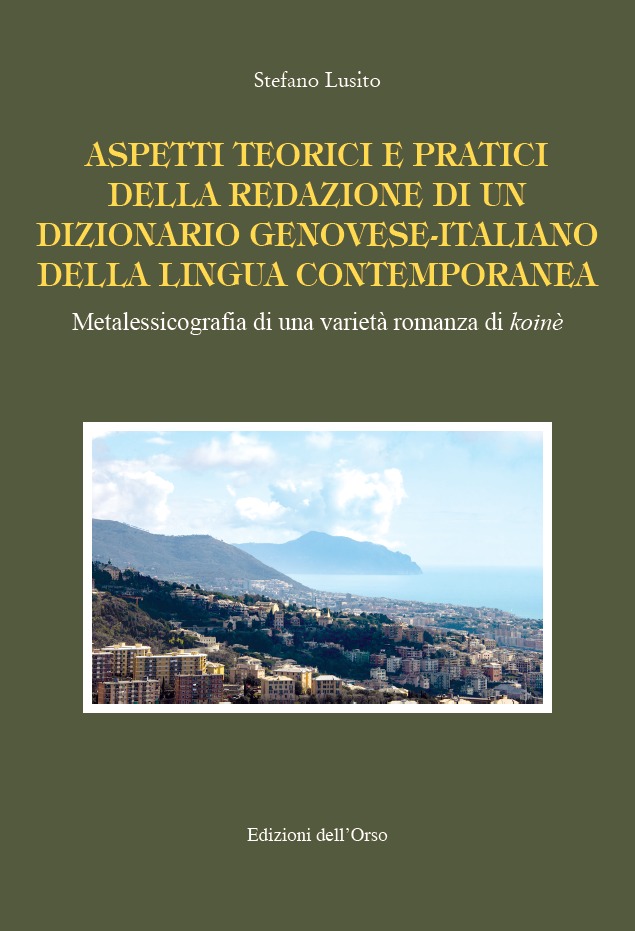
The award recognises his monograph Aspetti teorici e pratici della redazione di un dizionario genovese-italiano della lingua contemporanea: metalessicografia di una varietà romanza di koinè (Alessandria: Edizioni dell’Orso, 2025). The book examines the theoretical and practical challenges of contemporary Genoese lexicography, setting out a methodological framework for the compilation of a general-purpose Genoese–Italian dictionary. Particular attention is given to the conception of Genoese as a koine whose geographical reach extends beyond the city of Genoa itself, as well as to issues concerning the selection and treatment of lexical material, the structure of dictionary entries and the linguistic resources required for dictionary compilation. Alongside these metalexicographic considerations, the study also investigates phonetic and morphological features of Genoese attested in actual language use that have so far received relatively little scholarly attention, thereby contributing to a fuller understanding and more comprehensive documentation of this Romance variety.
Named in honour of the Italian linguist Tullio De Mauro, the Tullio De Mauro Prize is the scholarly component of the national “Salva la tua lingua locale” competition. It comprises three categories, devoted respectively to dictionaries, scholarly studies and undergraduate or postgraduate theses. Entries are assessed by a panel of scholars specialising in linguistics and dialectology, chaired by Salvatore Trovato and including Mari D’Agostino, Cristina Lavinio, Luca Lorenzetti and Giovanni Ruffino, the latter a member of the Accademia della Crusca.
The monograph is based on Lusito’s doctoral dissertation, which he defended at the University of Innsbruck in 2024 under the supervision of Professors Christine Konecny and Paul Danler. The dissertation had previously received the Hypo Tirol Bank Dissertationspreis in 2025, an award recognising doctoral research of outstanding scholarly merit.
This latest distinction follows the recognition received in Austria and forms part of a broader body of scholarly work encompassing research publications, edited volumes, scholarly editions of texts and participation in university research projects, with a particular focus on Ligurian dialectology, Romance lexicography and the linguistic documentation of Genoese and Monégasque.
Sunday, October 11, 2026
Seminar “Il genovese: lingua di cultura” at Palazzo della Borsa on 14 October
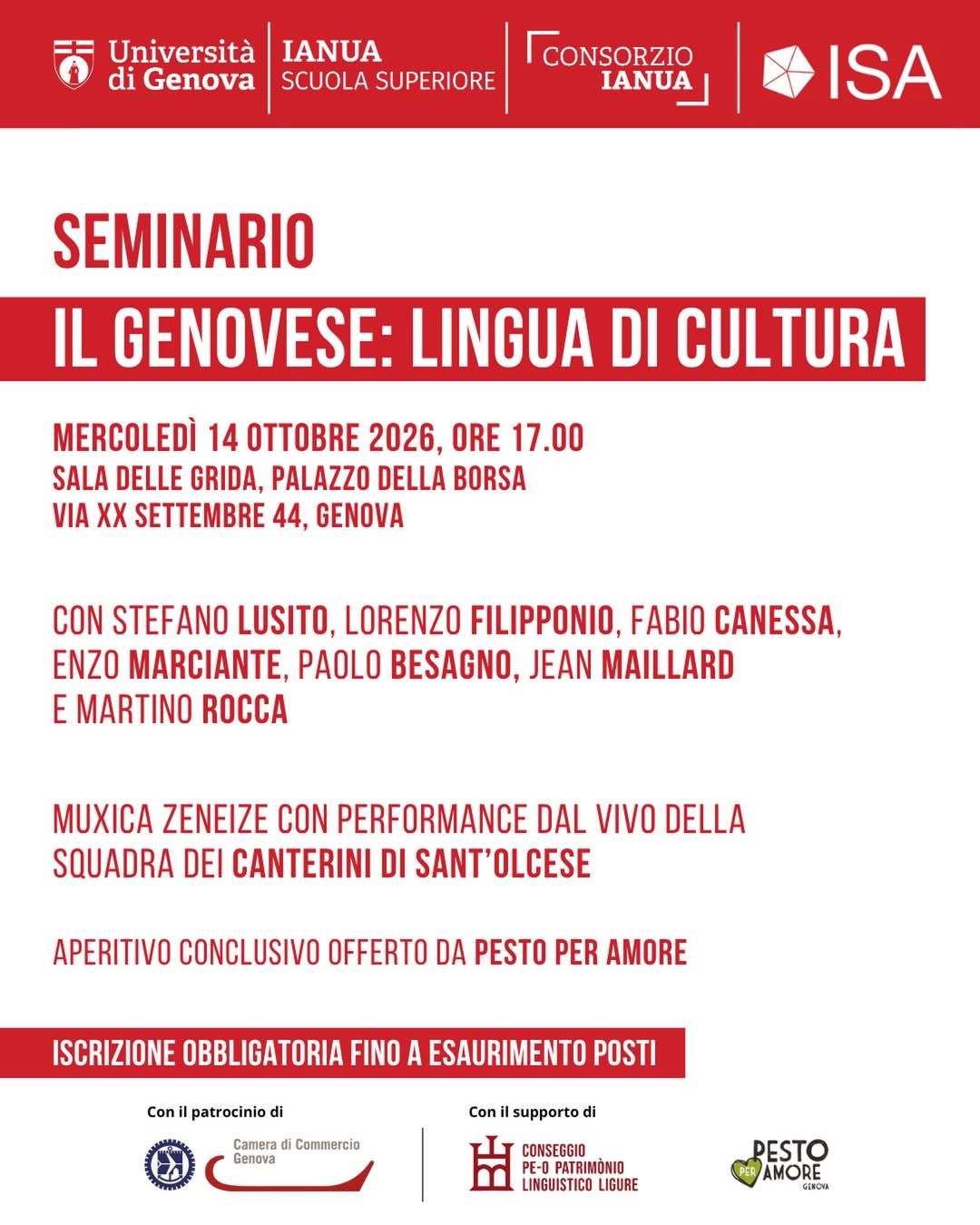
On Wednesday 14 October at 5pm, many of us will gather at Palazzo della Borsa for the seminar “Il genovese: lingua di cultura”, an afternoon devoted to Genoese as a living language, from research to the arts and technology.
Topics will include sociolinguistic status and orthography, journalism in Genoese, the Rolli palaces depicted in comics, and trallalero, with a live performance by the Canterini di Sant’Olcese. We will also discuss the application of artificial intelligence to the language.
The speakers include our members Paolo Besagno, Fabio Canessa, Stefano Lusito and Jean Maillard. Martino Rocca, also a member of the Council, will moderate the seminar.
The seminar is organised by the University of Genoa’s Scuola Superiore IANUA, Consorzio IANUA and ISA IANUA, with the support of the Council for Ligurian Linguistic Heritage. It will be followed at 7.30pm by a complimentary aperitivo offered by Pesto per Amore.
The event will take place in the Sala delle Grida at Palazzo della Borsa, Via XX Settembre 44, Genoa. It is open to everyone and will be held in Italian. Places are limited and registration is required: if you have not yet registered, you can do so using the registration form.
Saturday, September 26, 2026
Ligurian features in “Lara’s language journey through Italy”, the Council of Europe’s educational guide
Ligurian is among the languages featured in “Lara’s language journey through Italy”, a new educational guide for schools in Italy and across Europe, published by the Council of Europe’s European Centre for Modern Languages (ECML) to mark the European Day of Languages.
The booklet contains a short introduction to each language spoken in Italy, with common expressions, the numbers from one to ten and a QR code linking to audio recordings of the pronunciation of every word. Ligurian is introduced as “the language of Columbus and Genoa’s maritime empire”, which still “remains an important element of regional identity” today.
The guide introduces students to Italy’s rich linguistic heritage and encourages them to move beyond the idea of Italy as a monolingual country, pointing out that before 1861 over 95% of Italians did not speak Italian in everyday life. The spread of the national language in the twentieth century often led to the marginalisation of regional languages, whose use was often discouraged and punished in schools.
The publication explains that the so-called “regional languages” have been misleadingly called “dialects”, although they are languages in their own right, with their own grammar, history and literary traditions, and are recognised by international codes such as ISO 639‑3. Still spoken by millions of people, these languages form a cultural heritage that needs to be preserved.
Lara’s language journey through Italy is available free of charge (currently in English) on the project page and as a PDF download.
The project was developed in collaboration with CLIRD (Coordinamento Lingue Regionali e Diritti linguistici, the coordinating body for regional languages and linguistic rights), with specialist support from its member associations for the eight regional languages they represent (Emilian, Ligurian, Lombard, Neapolitan, Piedmontese, Romagnol, Sicilian and Venetian), including the Council for Ligurian Linguistic Heritage.
“It is a great source of satisfaction to see our linguistic heritage recognised in a Council of Europe initiative. We at the Council for Ligurian Linguistic Heritage are pleased to have contributed to this project, which gives younger generations the chance to discover the linguistic richness of Liguria and Italy,” says Jean Maillard, president of the Council for Ligurian Linguistic Heritage.
“‘Ligurian language’ is a term used internationally to refer to the Romance varieties spoken in Liguria or, to be more precise, the Romance varieties that linguists classify within the Ligurian group on the basis of specific criteria,” explains Stefano Lusito, a researcher in linguistics and a member of the Council. “This family also includes varieties spoken outside the region’s borders, such as Monégasque and Bonifacino. That said, when people speak of ‘Ligurian’, the reference variety is almost always Genoese, the most widespread variety and, above all, the one with the greatest historical prestige.”
Tuesday, 15 September 2026
Academic events on the Ligurian language on October 1, 2026
On 1 October, our member Stefano Lusito, who currently holds a research fellowship at the University of Genoa, will take part in two academic events in Genoa and Dolceacqua.
The first is his presentation “Denominazioni della fauna marina tra Liguria e Provenza: il caso del monegasco”, at 11.15am during the seminar “La terminologia del mare e degli oceani” at the University of Genoa (Via Balbi 4). The seminar is part of the activities of the university’s interdepartmental Centre for Research in Multilingual Terminology (Ce.R.Te.M.).
At 5.30pm, Lusito will speak at the linguistics seminar “Otto parole per quante lingue? | Huit mots pour combien des langues ?”, to be held in the council chamber of Dolceacqua Town Hall (Via Roma 50). Organised as part of the “MoPa – Parole di passaggio” project and funded by the VI-A France–Italy ALCOTRA 2021–2027 interregional cooperation programme, the event will focus on the linguistic features of the transition zone between Liguria and Provence. Lusito will be joined by Lorenzo Filipponio (University of Genoa) and Philippe Del Giudice (University of Nice).
Saturday, 12 September 2026
The first Ligurian keyboard prototype
After numerous preliminary experiments, members of the Council have produced the first physical prototype of a Ligurian keyboard.
It is the first keyboard designed to let people type the characters needed to write in all Ligurian varieties, including the vertical accents used in Monégasque. The layout takes account of how often the different characters are used, to make typing easier.
The testing phase will continue for a few more months, with the aim of producing further physical prototypes in 2027. Anyone interested in taking part in the testing can write to us at info@conseggio-ligure.org.
 Council for